In a moment of profound cultural and academic significance, the Tshwane University of Technology (TUT) has officially conferred an Honorary Doctorate of Philosophy in Science upon South African football icon Theophilus “Doctor” Khumalo. On Tuesday, April 28, 2026, the man who spent decades orchestrating the midfield for Kaizer Chiefs and Bafana Bafana walked across the stage at the Pretoria Campus to receive the university’s highest honor, forever changing his title from a beloved nickname to a formal academic designation.
The conferment ceremony was a star-studded affair, attended by sports administrators, government officials, and veterans of the 1996 Africa Cup of Nations winning squad. For the TUT community, this was more than just a celebratory event; it was a recognition of the “science of sport” and the immense contribution Khumalo has made to the social and physical fabric of the nation.
From Nickname to Reality
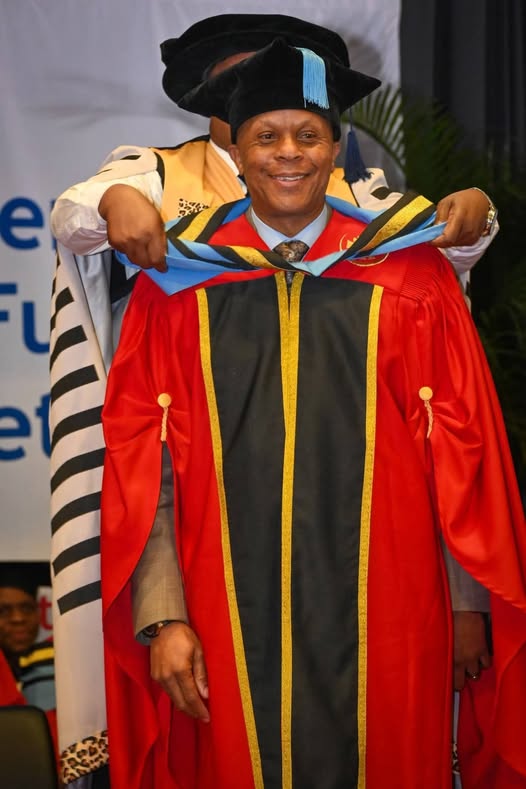
For over thirty years, the name “Doctor” was a moniker of endearment, a tribute to the surgical precision with which Khumalo dissected opposition defenses. However, the Honorary Doctorate of Philosophy in Science recognizes the technical, physiological, and strategic mastery Khumalo displayed throughout his career.
In their citation, the TUT Senate noted that Khumalo’s contribution to South African sport transcends mere entertainment. They highlighted his role in:
- Applied Sports Science: His intuitive understanding of spatial awareness, biomechanics, and tactical execution.
- Social Science: His ability to use football as a tool for national unity during South Africa’s delicate transition to democracy in the 1990s.
- Pedagogy: His ongoing work in youth development, where he translates complex technical skills into digestible lessons for the next generation of athletes.
The Science of the “No-Look” Pass
During the keynote address, academics at TUT drew parallels between Khumalo’s playing style and scientific principles. They spoke of his “peripheral vision and cognitive processing speeds” that allowed him to make split-second decisions under immense pressure.
By awarding him a Doctorate in Science, the university is making a bold statement: that elite sport is a discipline of the mind and body that deserves the same scholarly respect as traditional laboratory sciences. Khumalo’s career is being studied as a masterclass in human performance and strategic excellence.
A Humbled Legend Speaks
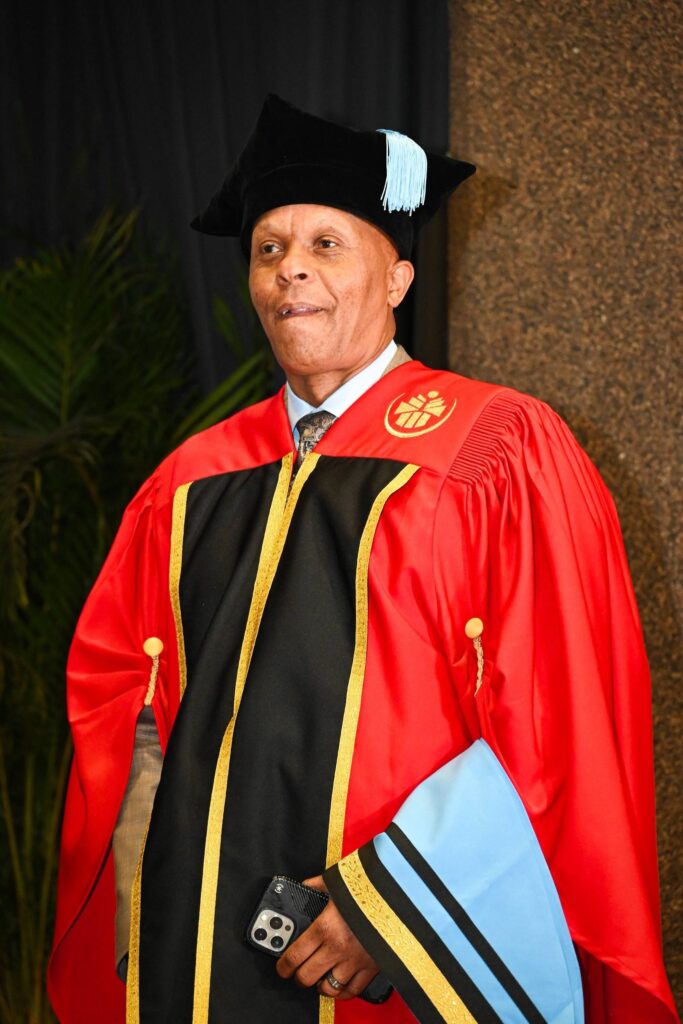
Draped in the red and blue academic regalia of TUT, Dr. Theophilus Khumalo addressed the congregation with a voice thick with emotion. He dedicated the honor to his late father, Eliakim “Pro” Khumalo, and to the millions of South Africans who found hope in football during the country’s darkest hours.
“I have stood in front of 90,000 people at FNB Stadium and felt the ground shake, but standing here today, being recognized by an institution of higher learning, is a different kind of victory,” Khumalo told the graduates. “This degree is not for me. It is for every young boy and girl in the townships who thinks that sports and books are two different worlds. I am here to tell you that they are one and the same. To play at the top, you need a scientist’s mind and an artist’s heart.”
Khumalo’s speech touched on the “longevity” of a career, urging current players to look beyond the glamour of the pitch and invest in their intellectual development. He emphasized that while physical speed fades with age, the “science of the game” remains with a person forever.
Impact on the Sporting Landscape
The recognition of Khumalo by a premier institution like TUT is expected to have a ripple effect across the South African sporting landscape. It reinforces the growing trend of Academic Professionalization in sport.
What this means for the future of SA Sport:
- Validation of Sports Careers: Elevating athletes to the status of “Doctors” helps remove the stigma that professional sport is a secondary career path to academia.
- Bridge Between Theory and Practice: Khumalo is expected to collaborate with TUT’s Faculty of Science on high-performance initiatives, bridging the gap between textbook sports science and the realities of the professional pitch.
- Inspiration for Youth: The image of “Doctor” Khumalo in a graduation gown provides a powerful visual for the “Student-Athlete” model, encouraging youth to pursue excellence in both arenas.
The “16 Valve” Legacy Lives On
TUT’s Vice-Chancellor, in his closing remarks, referred to Khumalo as a “living laboratory of excellence.” He noted that Khumalo’s nicknames—”Doctor” and “16 Valve”—now carry a weight of institutional authority.
The university has indicated that Khumalo will not merely be a titular doctor. He is expected to take on an advisory role within the university’s sports department, assisting in the development of a curriculum that focuses on the transition of professional athletes into administrative and scientific roles within the industry.
Conclusion: A New Chapter for Dr. Khumalo
As Dr. Theophilus Khumalo concludes his graduation week, he leaves behind a legacy that is no longer just written in goal-scoring records and assist tallies, but in the annals of South African academia. He has successfully navigated the journey from a township hero to a national icon, and now, to an esteemed man of science.
The “Doctor” has finally received his degree, and in doing so, he has given the South African public one more reason to cheer—not for a goal, but for the triumph of the human spirit and the pursuit of lifelong excellence.
Milestones of Dr. Theophilus Khumalo
| Milestone | Detail | Year |
|---|---|---|
| Professional Debut | Kaizer Chiefs FC | 1987 |
| International Triumph | AFCON Winner (Bafana Bafana) | 1996 |
| World Cup Appearance | FIFA World Cup, France | 1998 |
| Coaching Transition | Kaizer Chiefs Technical Team | 2012 |
| Academic Honor | Honorary Doctorate (TUT) | 2026 |