In the high-stakes world of political scions and international legal drama, few names command as much attention in Southern Africa as Bellarmine Chatunga Mugabe. The youngest son of the late Zimbabwean strongman Robert Mugabe has long been a fixture of the Johannesburg social scene, but on Wednesday, April 29, 2026, his lifestyle of luxury faced its most significant threat yet.
Following a grueling legal battle at the Alexandra Magistrate’s Court, the 29-year-old managed to pull off a stunning “legal escape,” avoiding a potential ten-year prison sentence. Instead of a jail cell, Chatunga was met with a massive fine and an immediate deportation order, effectively ending his long and controversial residency in South Africa.
The Hyde Park Shooting: A Night of Chaos
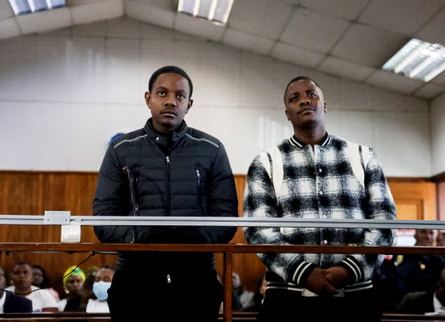
The case that nearly brought down the Mugabe heir began in February 2026 at his lavish residence in Hyde Park, Sandton. What was initially reported as a domestic dispute quickly escalated into a violent confrontation involving a firearm.
According to court transcripts, an altercation broke out between Chatunga’s entourage and a 23-year-old employee, Sipho Mahlangu. During the fray, Mahlangu was shot in the back as he attempted to flee the premises. He was left with life-altering injuries, and the South African Police Service (SAPS) moved quickly to arrest both Chatunga and his cousin, Tobias Matonhodze.
The initial charges were severe: Attempted Murder, Possession of an Unlicensed Firearm, and Violation of the Immigration Act. For months, it seemed certain that the “Prince of Harare” would be the first of the Mugabe children to serve significant time in a South African correctional facility.
The Plea Deal: Breaking Down the Verdict

The turning point in the trial came this week when Chatunga’s high-powered legal team negotiated a comprehensive plea agreement with the National Prosecuting Authority (NPA). The strategy was clear: shift the primary criminal liability to his cousin while addressing Chatunga’s peripheral involvement and immigration status.
The court delivered a sentence focused on financial restitution rather than incarceration:
- Immigration Violations: Chatunga was fined R200,000 for overstaying his visa and failing to maintain legal residency status in South Africa.
- Pointed Object Charge: The attempted murder charge against Chatunga was dropped in exchange for a guilty plea to a lesser charge of “pointing an object resembling a firearm.” For this, he was fined R400,000.
- Compensation: In a move that heavily influenced the Magistrate’s decision, Chatunga reached a private settlement with the victim, Sipho Mahlangu. Reports indicate an initial payment of R250,000 was made toward Mahlangu’s medical bills and rehabilitation, with a further R150,000 structured for future support.
While Chatunga walked free, his cousin Tobias Matonhodze was not as fortunate. Matonhodze pleaded guilty to the actual shooting and was sentenced to three years of direct imprisonment.
Immediate Deportation: The End of an Era
While Chatunga avoided the “inside” of a prison, the South African government ensured he would no longer enjoy the “outside” of Sandton. Immediately following the sentencing, Department of Home Affairs officials took custody of the former president’s son.
By 6:00 PM on Wednesday, Chatunga was escorted under heavy guard to OR Tambo International Airport. Under the terms of his deportation, he has been declared persona non grata in South Africa for a minimum of five years. This marks a dramatic fall for a man who once headlined the most exclusive parties in Johannesburg and Cape Town.
Public Reaction: Justice or Privilege?
The verdict has reignited a fierce debate regarding “chequebook justice” in South Africa. Civil rights groups and opposition parties have been quick to criticize the outcome, arguing that a regular citizen without the Mugabe name or financial resources would likely be languishing in a jail cell.
“What we saw today was the power of money over the rule of law,” said an activist from a local crime-watch group. “When you can pay half a million rand in fines and give the victim a ‘settlement’ to walk away, it sends a message that the law is a suggestion for the wealthy but a hammer for the poor.”
However, the NPA defended the decision, stating that the primary goal—removing a non-compliant foreign national and ensuring compensation for the victim—was achieved without the cost and uncertainty of a multi-year trial.
The Mugabe Legacy in the 2020s
The legal troubles of the Mugabe brothers (Chatunga and his older brother Robert Jr.) have been a persistent thorn in the side of both the South African and Zimbabwean governments. Since the passing of their father in 2019, the brothers have often been in the headlines for “extravagant” behavior and occasional brushes with the law.
This latest incident in Hyde Park, however, was the first time the stakes involved life-threatening violence. With Chatunga now back in Zimbabwe under the watchful eye of the Emmerson Mnangagwa administration, many wonder if this “near-miss” with prison will finally lead to a change in lifestyle.
Conclusion: A Hollow Victory
Bellarmine Chatunga Mugabe may have avoided jail time, but he has lost his playground. The glitzy malls of Sandton and the high-walled villas of Johannesburg are now closed to him. As he landed in Harare late Wednesday night, he returned to a country where his family’s legacy is complex and his own reputation is under more scrutiny than ever.
The “Prince” has escaped the tower, but the gates to his kingdom are narrower than they used to be.
Case Summary: The State vs. B.C. Mugabe
| Legal Factor | Detail |
| Original Charge | Attempted Murder |
| Final Conviction | Immigration Violation & Pointing a Toy Firearm |
| Total Fines Paid | R600,000 |
| Victim Settlement | R250,000 (Initial) |
| Current Status | Deported to Zimbabwe |
| Travel Status | Banned from SA for 5 years |
Do you believe that deportation and heavy fines are a sufficient punishment for high-profile offenders?