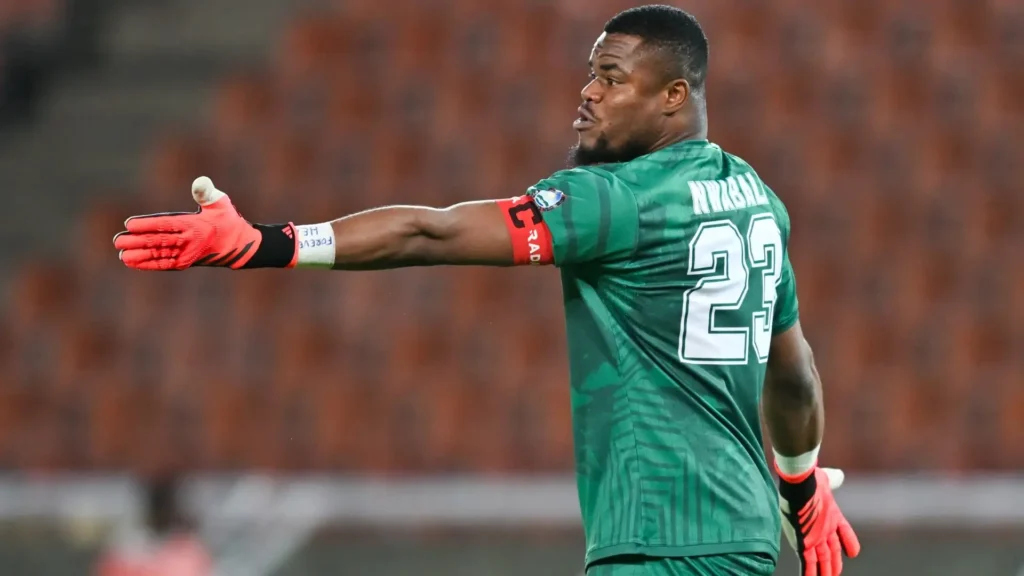
The landscape of African club football has long been defined by a quiet exodus of talent moving from West to South. While the narrative often focuses on “stepping stones to Europe,” Super Eagles goalkeeper Stanley Nwabali has pulled back the curtain on a much harsher reality: the staggering financial and structural disparity between the Nigeria Premier Football League (NPFL) and South Africa’s Betway Premiership (PSL).
In a candid interview on April 13, 2026, the former Chippa United shot-stopper delivered a blunt assessment of the West African football scene, labeling the local leagues “subpar” compared to those in South Africa and Morocco. For Nwabali, the reason players flee Nigeria isn’t just about ambition—it’s about survival and professional dignity.
The Numbers That Sting: $900 vs. $11,000

The most jarring aspect of Nwabali’s critique lies in the cold, hard numbers. As of 2026, the financial gulf between a top-tier Nigerian club and a mid-table South African side is not just a gap; it is a canyon.
- The NPFL Reality: Reports indicate that even the highest-paid goalkeepers in the Nigerian domestic league earn between $880 and $955 per month. While stars like Ahmed Musa can command higher figures (roughly $3,680), they are the extreme exceptions in a league where the average professional struggles to maintain a middle-class lifestyle.
- The PSL Reality: During his tenure at Chippa United—a club often fighting in the lower half of the South African table—Nwabali reportedly earned approximately $11,000 per month.
When a goalkeeper can earn ten times his home salary by moving to a “smaller” club in South Africa, the choice becomes a mathematical certainty. “If your league is nice, you’re getting paid, you’re getting sponsors, what are you leaving for?” Nwabali asked rhetorically.
More Than a Paycheck: Structure and Infrastructure
Nwabali’s “slam” of the West African system extended beyond the bank balance. He highlighted that the Betway Premiership and Morocco’s Botola Pro offer a level of professionalism that the NPFL currently lacks.
The Nigerian international pointed to three key pillars where South Africa holds the edge:
- Administrative Stability: The PSL is widely regarded as the most professionally run league on the continent. Reliable schedules, transparent officiating, and robust player welfare policies provide a sense of security that is often absent in West Africa.
- Sponsorship and Branding: The influx of corporate sponsors in South Africa ensures that clubs can honor contracts. In Nigeria, players frequently face “salary backlogs,” where they may go months without receiving their promised wages.
- Facilities: Nwabali contrasted the “state-of-the-art stadiums” of South Africa and Morocco with the deteriorating pitches often found in the West. For a goalkeeper, the quality of the surface isn’t just an aesthetic choice—it’s a matter of career longevity and injury prevention.
The “Echo Chamber” of West African Football
One of Nwabali’s most poignant observations was the lack of incentive for players in South Africa or Morocco to seek moves to mid-level European leagues. Because the pay in the PSL is “nice for a certain level,” players like Ronwen Williams or Thembinkosi Lorch (who has reportedly earned upwards of $66,000 a month) can afford to stay at home unless a top-tier European giant calls.
In contrast, Nigerian players are often forced to move to obscure leagues in Eastern Europe or Asia simply because the financial reward—even in a second-tier foreign league—outstrips what they could earn at Enyimba or Remo Stars.
“In West Africa, our leagues are not as good. We want to go to Europe, we want to come to South Africa, we want to go to Morocco… if your league is nice there’s no point of you leaving.” — Stanley Nwabali
The Future: A Call for Reform
Nwabali’s comments come at a time of transition for him personally. Having recently parted ways with Chippa United, the 29-year-old is a man in demand, with links to major clubs in the Middle East and South Africa’s “Big Three.”
However, his words serve as a final warning to Nigerian football administrators. As long as the salary gap remains this vast and the infrastructure remains neglected, the NPFL will continue to serve as a “feeder league” rather than a destination.
For the fans, Nwabali is a hero for speaking the truth. For the administrators, he is a reminder that talent alone cannot sustain a league—it requires the “nice” things he spoke of: sponsors, stadiums, and, most importantly, a fair wage for the men who provide the entertainment.
As the 2026 World Cup qualifiers loom, Nwabali’s perspective suggests that the strength of the Super Eagles will continue to depend on foreign-based players until the domestic foundation is finally reinforced with more than just empty promises.