The passing of Cynthia Shange marks the end of an era for the South African entertainment industry. As one of the country’s most enduring cultural icons, Shange’s journey from a trailblazing model to a legendary actress on both the big and small screens is a story of resilience, grace, and an unwavering commitment to her craft. At the age of 77, the woman who famously portrayed MaNzuzu in the beloved soapie Muvhango has taken her final bow, leaving behind a legacy that has shaped the aspirations of generations.
Cynthia Shange’s story is not just one of stardom; it is a mirror of South African history itself—a narrative of breaking barriers during an era where the odds were heavily stacked against Black artists, particularly women.
The First Black Miss South Africa: A Trailblazer in Gold

Long before she became a household name in television, Cynthia Shange made history in the world of pageantry. In 1972, at a time when South Africa was deeply entrenched in the segregation of the Apartheid era, Shange was crowned the first Black Miss South Africa. This was a monumental achievement that transcended the world of fashion; it was a defiant statement of Black beauty and excellence on a national stage.
Winning the title earned her the right to represent the country at the Miss World pageant in London later that year. While she faced the immense pressure of representing a divided nation, she carried herself with a poise that would become her trademark. Her success in modeling opened doors that had previously been locked, proving that South African talent was world-class, regardless of race.
The Transition to the Silver Screen
Shange’s transition from the runway to the screen was seamless, but it was grounded in hard work. She burst into the cinematic world in the mid-1970s, most notably starring in South Africa’s first-ever Black feature film, Udeliwe (1975). The film was a cultural phenomenon, and Shange’s performance established her as a formidable actress capable of carrying a lead role.
She later became a central figure in the iconic television series Shaka Zulu (1986), playing the role of Mkabi. Working alongside greats like Henry Cele, Shange helped bring the story of the Zulu Kingdom to a global audience. Her ability to inhabit characters with a mixture of royal authority and deep maternal warmth became her “signature,” leading to a career that spanned over five decades.
The Matriarch of Muvhango
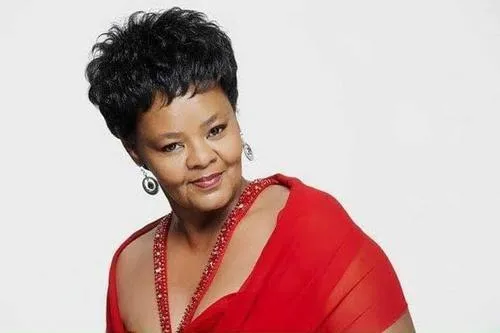
For the modern generation of television viewers, Cynthia Shange will forever be remembered as MaNzuzu in the SABC 2 soapie Muvhango. Joining the show in its early years, she played the matriarch of the Nzuzu family, a character who was often the moral compass of the series.
Her portrayal of MaNzuzu was more than just a job; it was a cultural touchstone. She embodied the “African Mother”—strong, traditional, yet deeply empathetic. Her chemistry with co-stars and her mastery of the Zulu language brought an authenticity to the screen that resonated with millions of viewers every weeknight. When she eventually retired from the show after nearly 20 years, it felt as though a member of the family had moved away.
A Mother to the Nation and Her Family
Off-screen, Cynthia Shange was a devoted mother and grandmother. Her daughter, Nonhle Thema, followed in her footsteps to become a prominent media personality and actress. The bond between the two was frequently highlighted in the media, with Nonhle often crediting her mother for her strength and professional guidance.
Shange’s life was not without its trials, but she navigated the public eye with a level of dignity that earned her the title of “The Queen Mother” of South African acting. She was a mentor to many young actors at the SABC, often seen offering advice on set about everything from script delivery to managing the pressures of fame.
Tributes and National Mourning
As news of her passing spread, tributes poured in from government officials, fellow actors, and fans across the African continent. The Department of Sport, Arts, and Culture hailed her as a “national treasure,” noting that her contribution to the arts helped define the South African identity during the country’s most transformative years.
“Cynthia Shange did not just act; she taught us how to be proud of who we are,” one colleague remarked during a radio tribute. “She carried the history of our struggle and the joy of our liberation in every role she played.”
The Final Curtain
The burial of Cynthia Shange is expected to be a state-assisted affair, reflecting her status as a cultural pioneer. As the industry gathers to say its final goodbyes, the focus remains on the immense body of work she left behind. From the grainy black-and-white films of the 70s to the high-definition sets of modern soapies, her presence remained constant.
Cynthia Shange’s passing marks the closing of a magnificent chapter, but the book of her life remains open as a manual for any young artist seeking to understand the meaning of “longevity.” She proved that beauty is timeless, but talent and character are the true currencies of a lasting career.
Rest in power, Mam’ Cynthia. You have walked your path with the grace of a queen and the heart of a mother. Hamba kahle, MaShange.