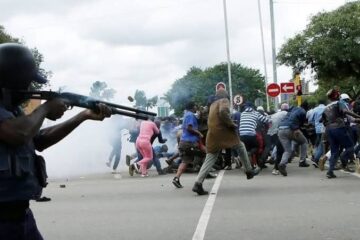
In a fiery and polarizing address that has ignited debate across South African social media, cultural activist and former radio host Ngizwe Mchunu has launched a scathing attack on the nation’s political leadership. Speaking from KwaZulu-Natal on Tuesday, May 5, 2026, Mchunu—the self-styled “President of the Amabhinca”—argued that the country’s current economic and social woes are a direct result of politicians “surrendering” South Africa’s borders to illegal foreigners.
Mchunu’s rhetoric, delivered with his trademark theatrical flair and deep isiZulu linguistic nuances, moved beyond mere cultural pride into a hardline stance on national sovereignty. He accused the government of allowing the country to become a “no-man’s land,” where illegal immigration is used by the elite as a tool for cheap labor while the native working class descends into poverty.
“The Gatekeepers are Asleep”: The Sovereignty Argument
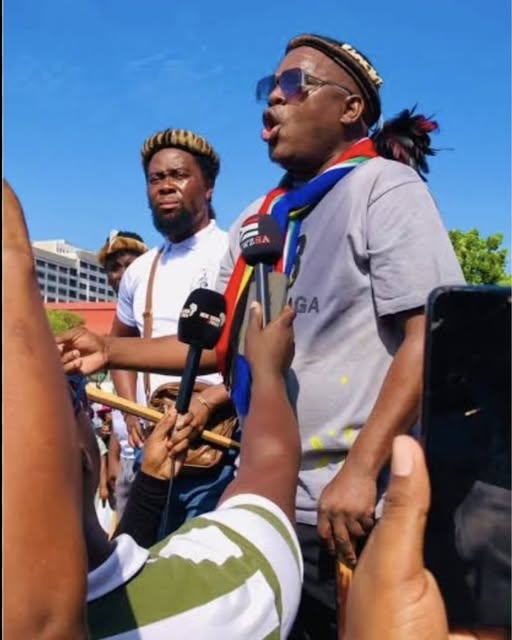
Mchunu’s primary grievance is that the South African government has failed in its most fundamental duty: protecting its borders. He argued that the presence of undocumented foreign nationals is not a failure of the people, but a catastrophic failure of the Department of Home Affairs and the SAPS.
“A home without a fence is not a home; it is a thoroughfare,” Mchunu declared during his live digital broadcast. “Our politicians have taken the gates off the hinges. They have allowed people to enter this country without names, without fingerprints, and without respect for our laws. Today, we are a country of ghosts, and the politicians are the ones who signed the death warrant of our sovereignty.”
He went on to claim that the “porous borders” have led to a breakdown in national security, suggesting that untraceable individuals make it impossible for the police to solve crimes in townships like Hammarsdale and Inanda.
Economic Despair and the Competition for Resources
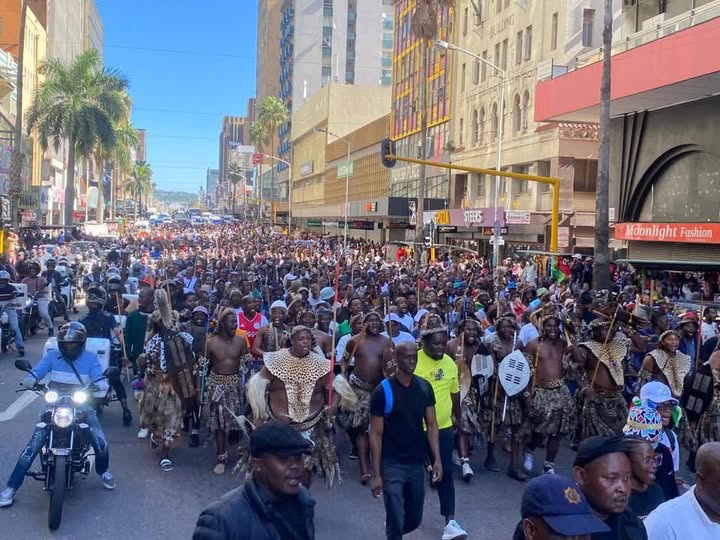
The crux of Mchunu’s argument is the economic impact on the “ordinary man.” In a climate where fuel prices have just seen a massive hike and unemployment remains at record highs, Mchunu positioned the illegal immigration crisis as a primary driver of domestic hardship.
Mchunu’s Economic Accusations:
- The Informal Economy: He slammed politicians for allowing foreign nationals to dominate the spaza shop and informal trading sectors, which he claims has “strangled” local entrepreneurship.
- Labor Exploitation: He accused “white monopoly capital” and corrupt business owners of hiring undocumented workers to avoid paying minimum wage, thereby leaving South African youth on the sidelines.
- Service Delivery Strain: Mchunu argued that hospitals and schools are buckling under the weight of a population that is far larger than official census data suggests, leading to the “ICU state” of public services.
“Selling the Birthright”: Attacks on the Political Class
Mchunu did not spare any political party, though his sharpest barbs were reserved for those currently in power. He accused politicians of being “scared” to enforce the law for fear of international condemnation, suggesting they prioritize their “global image” over the safety of South African citizens.
“They go to the African Union and smile for cameras while our mothers are being robbed in the streets by people who shouldn’t be here,” he shouted. “They have sold the birthright of the Zulu, the Xhosa, the Sotho, and the Tswana for the sake of being called ‘pan-Africanists’ in fancy hotels.”
He further alleged that certain politicians benefit from illegal immigration through the “under-the-table” sale of identity documents and work permits, calling it a “mafia state” operation that enriches the few while the many suffer.
A Warning of Social Implosion
Mchunu’s speech comes at a time of extreme tension. With vigilante groups like Operation Dudula and other “South Africa First” movements gaining traction in 2026, Mchunu’s words provide a powerful cultural backing to a movement that many human rights organizations have labeled as xenophobic.
However, Mchunu rejected the “xenophobic” label, claiming instead that he is a “legalist.” He argued that his grievance is not with Africans, but with illegality.
“Do not call me a hater of my brothers,” he said. “I am a lover of my country. If you enter my house through the window in the middle of the night, you are not a guest; you are an intruder. Our politicians have turned South Africa into a house with no windows and no doors.”
He warned that if the state does not immediately implement a mass deportation and border-securing strategy, the “patience of the ground” will expire, potentially leading to widespread civil unrest as citizens seek to “self-police” their neighborhoods.
The Controversy and the Critique
Critics of Mchunu argue that his rhetoric is dangerous and simplifies a complex geopolitical issue. Human rights activists point out that blaming illegal foreigners for the failure of the government to manage the economy is a classic “diversionary tactic” used by populists.
“Ngizwe is pointing at the person next to him instead of the person above him,” said one political commentator. “The fuel hikes, the load shedding, and the corruption are not caused by a shopkeeper in a township. They are caused by the very politicians he claims to be slamming, but he uses the immigrant as the shield.”
Conclusion: A Divided Nation
Regardless of the critique, Mchunu’s message is finding a massive audience. In the rural heartlands and the sprawling townships of Gauteng and KZN, his words are seen as “the truth that nobody else is brave enough to say.”
As South Africa moves deeper into 2026, the intersection of political failure and illegal immigration has become the most volatile fault line in the country. Ngizwe Mchunu has placed himself at the center of this storm, demanding a “South Africa for South Africans” and promising that the “Amabhinca” will no longer remain silent while their country is “given away.”
Summary of Mchunu’s “Sovereignty Crisis” (May 2026)
| The Problem | Mchunu’s Claimed Cause |
| High Crime | Untraceable, undocumented individuals. |
| Youth Unemployment | Labor exploitation of illegal foreigners. |
| Crumbling Clinics | Overpopulation due to porous borders. |
| Political Inaction | Politicians being “captured” by globalism. |
| The Solution | Strict border control and immediate deportations. |