In the bustling streets of Johannesburg’s CBD and along the dusty transit routes of the North West, the face of South African law enforcement is undergoing a radical, high-tech makeover. As of May 2026, the days of manual document checks and lengthy “verify-later” detentions are being replaced by a sophisticated digital dragnet. Led by the South African Police Service (SAPS) and the Border Management Authority (BMA), the government has launched a series of “on-the-spot” enforcement measures powered by biometrics, drones, and AI.
This shift, formalized under initiatives like Operation New Broom and the intensified Operation Shanela, represents a “zero-tolerance” approach to undocumented migration. For the first time, technology is allowing officers to turn a standard traffic stop or a township raid into an instant, high-stakes immigration tribunal.
The Rise of Mobile Biometric Verification
The centerpiece of this new era is the rollout of Mobile Biometric Scanners. During multidisciplinary roadblocks—such as the massive inter-provincial operation conducted at the North West–Northern Cape border in April 2026—officers are no longer just looking for stolen goods.
Equipped with handheld devices linked directly to the Department of Home Affairs’ Electronic Movement Control System (EMCS), police can now perform instant facial recognition and fingerprint checks. If an individual is stopped and cannot produce a physical permit, their biometrics are scanned on the spot. Within seconds, the system cross-references national databases to determine if the person has a valid visa, has overstayed, or has ever entered the country legally.
“Digitalization has closed the door on fraudulent documentation,” stated Minister of Home Affairs Dr. Leon Schreiber in a recent briefing. “We are moving away from a system of ‘paper trails’ to a system of ‘biometric truth’.”
Operation Shanela and “On-the-Spot” Raids
The integration of this tech into Operation Shanela—the SAPS’s nationwide crime sweep—has seen a staggering increase in immigration-related arrests. In just one week between April and May 2026, police arrested over 1,400 individuals for illegal migration-related offenses.
Unlike previous years, where undocumented persons might be held for days while their status was verified at a station, the new tech allows for instant adjudication. If the mobile system flags an individual as “undesirable” or “inadmissible,” the BMA border guards can begin the deportation process immediately. In the Easter period of 2026 alone, the BMA intercepted and processed nearly 5,000 individuals attempting to enter or exit illegally, utilizing these rapid-check systems.
Eyes in the Sky: Drones and AI Surveillance
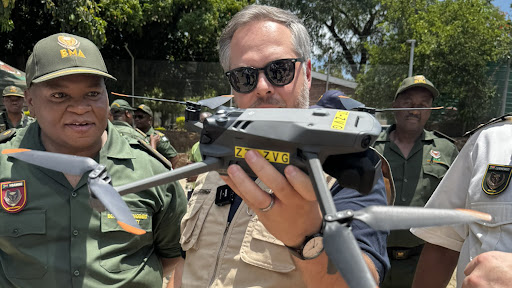
The “on-the-spot” checks aren’t just happening on the roads; they are happening at the borders themselves. The BMA has deployed a fleet of high-endurance surveillance drones along the Limpopo and Caledon rivers.
These drones are equipped with thermal imaging and AI-driven motion detection that can distinguish between wildlife and human movement in pitch-black conditions. When a crossing is detected, ground teams are dispatched with mobile tech to intercept and verify the individuals before they can disappear into the interior of the country.
Impact of Tech-Driven Enforcement (2025 vs. 2026):
| Metric | 2025 (Manual) | 2026 (Digital) |
| Verification Time | 4–24 Hours | 30–60 Seconds |
| Illegal Crossing Detection | 12% Success Rate | 36% Success Rate |
| Deportation Efficiency | Low (Paper-heavy) | High (Biometric-linked) |
| Fraudulent Visa Detection | Difficult | Instant via AI Scanning |
The “Electronic Travel Authorisation” (ETA) System
Adding a layer of “pre-emptive” enforcement is the new Electronic Travel Authorisation (ETA). Launched alongside the G20 summit, this system uses machine learning to adjudicate visa applications instantly. It is now being expanded to all major land borders, meaning that anyone entering the country must have their facial biometrics pre-cleared. This prevents undocumented asylum seekers from entering the country and applying “inland,” a major shift in South African immigration policy.
The Human Rights Debate
While the government celebrates a 46% increase in deportations and a decline in illegal crossings, the use of “on-the-spot” biometric checks has drawn scrutiny from human rights groups. Activists argue that the speed of the technology may bypass necessary judicial oversight, leading to the deportation of legitimate asylum seekers before they can plead their case.
However, the state remains firm. President Cyril Ramaphosa emphasized during the 2026 State of the Nation Address (SONA) that the “National Illicit Economy Disruption Programme” (Operation Ukubusa) will continue to leverage data analytics and AI to restore border integrity.
Conclusion: No More “Hiding in the Gaps”
The 2026 crackdown represents a fundamental shift in South African policing. By placing the power of the national biometric database into the palm of a police officer’s hand, the state is effectively removing the “gaps” that undocumented people once used to navigate the country.
As technology continues to evolve—with plans for a world-class digital forensics laboratory already in motion—the message to those entering South Africa is clear: the digital eye is watching, and it never blinks.